Tax on Interest UK: How Much Tax Do You Pay on Savings Interest?
Tax on interest UK depends mainly on your total income, Income Tax band, and the type of account or investment generating the interest. Many people can earn some savings Tax on Interest UK tax free through the Personal Allowance, Starting Rate for Savings, or Personal Savings Allowance.
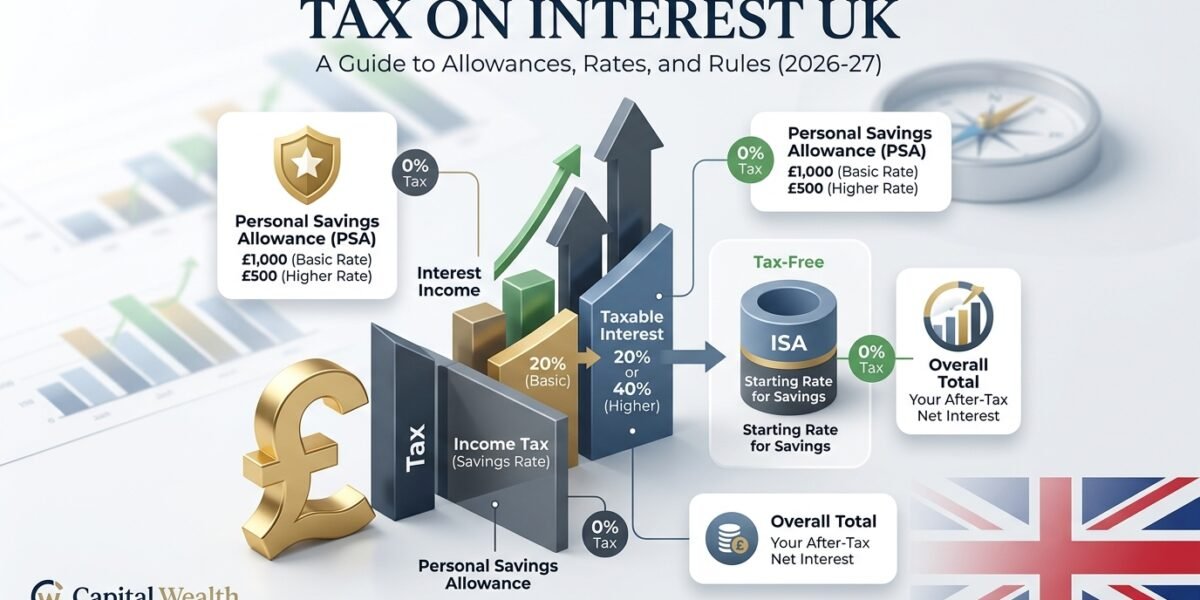
For the 2026–27 tax year, which runs from 6 April 2026 to 5 April 2027, the Personal Savings Allowance is £1,000 for basic rate taxpayers, £500 for higher rate taxpayers and £0 for additional rate taxpayers. Some lower income savers may also qualify for the Starting Rate for Savings, which can provide up to £5,000 of savings interest at a 0% tax rate.
This guide explains how tax on savings interest works in the UK, which interest is taxable, how the different allowances interact, what happens when you exceed your allowance, and how ISAs can provide tax free interest.
What Is Tax on Interest in the UK?
Tax on Interest UK is Income Tax that may apply to interest you receive from savings and certain investments.
Tax on Interest UK can come from several sources, including bank accounts, building society accounts, savings accounts, credit union accounts, government or company bonds, peer to peer lending and some investment products. HMRC generally treats this type of Tax on Interest UK as savings income.
The important point is that receiving interest does not automatically mean you have to pay tax on all of it.
The amount you can receive tax free depends on your other income and your tax position. For some people, the available tax free amount can be substantial because different rules may apply through the Personal Allowance, Starting Rate for Savings and Personal Savings Allowance.
Tax on Interest UK earned inside certain tax free products, particularly ISAs, is treated differently and does not count towards your Personal Savings Allowance.
How Does Tax on Savings Interest Work?
The easiest way to understand Tax on Interest UK is to look at the different allowances and tax bands that can apply.
For the 2026–27 tax year, the main savings related rules include:
| Tax rule | 2026–27 treatment |
|---|---|
| Personal Allowance | £12,570 |
| Starting Rate for Savings | Up to £5,000 at 0% |
| Personal Savings Allowance for basic rate taxpayers | £1,000 |
| Personal Savings Allowance for higher rate taxpayers | £500 |
| Personal Savings Allowance for additional rate taxpayers | £0 |
| Savings basic rate | 20% |
| Savings higher rate | 40% |
| Savings additional rate | 45% |
The standard Personal Allowance is £12,570, although it can be reduced for people with adjusted net income above £100,000.
The Starting Rate for Savings can provide up to £5,000 of tax free savings tax on Interest UK to people with sufficiently low non savings income. The Personal Savings Allowance then provides another tax free band depending on the taxpayer’s Income Tax band.
These rules can be complicated because the allowances do not simply mean that everyone can automatically earn £5,000 plus £1,000 of interest tax free. Your other income affects whether and how much of the Starting Rate for Savings is available.
What Is the Personal Savings Allowance?
The Personal Savings Allowance is the amount of savings Tax on interest UK you can receive without paying Income Tax, depending on your Income Tax band.
For 2026–27:
- Basic rate taxpayers can receive up to £1,000 of savings interest tax free.
- Higher rate taxpayers can receive up to £500 tax free.
- Additional rate taxpayers have no Personal Savings Allowance.
HMRC determines the relevant tax band by considering your other income together with your savings tax on Interest UK.
For example, suppose a hypothetical basic rate taxpayer receives £700 of interest from ordinary savings accounts during the tax year. If the person remains within the basic rate position and has enough Personal Savings Allowance available, the £700 could fall within the £1,000 allowance and no additional tax would be due on that interest.
Now suppose the same person receives £1,400 of interest. The first £1,000 could fall within the Personal Savings Allowance, leaving £400 potentially taxable at the applicable savings tax rate.
The exact calculation depends on the person’s full income position.
What Is the Starting Rate for Savings?
The Starting Rate for Savings is a separate 0% tax band designed to help people with relatively low non savings income.
For 2026–27, eligible taxpayers can receive up to £5,000 of savings income at a 0% rate. However, the full £5,000 is not automatically available to everyone.
If your other income is below the Personal Allowance plus £5,000, your Starting Rate for Savings can be reduced depending on how much other income you have above the Personal Allowance. If your other income is £17,570 or more, you are not eligible for the Starting Rate for Savings.
For example, suppose a hypothetical person earns £16,000 from employment and receives £200 of bank interest.
With a £12,570 Personal Allowance, £3,430 of employment income sits above that allowance. That reduces the potential £5,000 Starting Rate for Savings by £3,430, leaving a potential starting savings rate band of £1,570. The person’s £200 interest could therefore fall within that 0% band. HMRC gives a similar example in its guidance.
This is why low income savers should not assume that the Personal Savings Allowance is the only tax free provision available.
What Are the UK Tax Rates on Savings Interest?
For the 2026–27 tax year, savings income is generally taxed at:
- 20% at the basic savings rate
- 40% at the higher savings rate
- 45% at the additional savings rate
The Starting Rate for Savings is 0% where applicable, and the Personal Savings Allowance provides a 0% band for qualifying interest depending on the taxpayer’s tax band.
The tax rate that applies to taxable Tax on Interest UK is therefore linked to your overall tax position.
This is particularly important for people whose income is close to the boundary between tax bands. Savings Tax on Interest UK can affect which tax band applies to some of your income because the interest is included when determining the overall tax position.
What About Scotland?
Scotland has different Income Tax on Interest UK bands for non savings and non dividend income. However, savings income uses the UK savings rates. For 2026–27, the savings rates are 0% for the Starting Rate for Savings where applicable, 20% basic, 40% higher and 45% additional, with the Personal Savings Allowance rules applying according to your tax band.
This distinction matters because someone living in Scotland should not simply use the Scottish non savings tax bands to calculate tax on bank interest.
Which Types of Interest Are Taxable?
Tax can potentially apply to Tax on Interest UK from several types of savings and investments.
HMRC lists interest from sources including:
- Bank and building society accounts
- Savings and credit union accounts
- Government and company bonds
- Peer to peer lending
- Trust funds
- Some investment funds
- Certain life insurance contracts
- Some annuity payments
- Certain PPI related interest
The tax treatment can differ depending on the specific product and circumstances.
This means you should not assume that only traditional savings accounts matter when calculating your taxable savings income.
If you have several accounts, it is useful to keep records of the interest paid during the tax year so you can understand your total savings income.
Is Interest from a Bank Account Taxable in the UK?
Bank account Tax on Interest UK can be taxable, but you may not actually owe tax if the interest falls within an available tax free allowance.
For example, a person with a normal savings account might receive £600 of interest during a tax year. If that person is a basic rate taxpayer with sufficient Personal Savings Allowance available, the £600 could be covered by the £1,000 allowance.
A higher rate taxpayer with the same £600 interest could potentially have £500 covered by the Personal Savings Allowance, leaving £100 potentially subject to the applicable savings tax rate.
These are hypothetical examples rather than predictions of an individual’s tax bill.
Is saving on Interest in an ISA Taxable?
Tax on Interest uk earned inside an ISA is generally tax free.
HMRC states that you do not pay tax on Interest UK from cash ISAs, and ISA income and capital gains generally do not need to be declared on a tax return.
For the 2026–27 tax year, the overall ISA subscription limit is £20,000. This is the amount you can subscribe across your ISAs subject to the applicable ISA rules.
An important distinction is that ISA interest does not use up your Personal Savings Allowance. HMRC specifically states that savings in tax free accounts such as ISAs do not count towards the Personal Savings Allowance.
For someone who regularly earns substantial Tax on interest UK, understanding the difference between an ordinary savings account and a tax free ISA can therefore be important.
What Happens If Your Savings Interest Is Above the Allowance?
If your taxable savings Tax on Interest UK exceeds the available tax free allowances, the excess can be subject to Income Tax.
For example, imagine a hypothetical basic rate taxpayer receives £1,500 of taxable savings interest and has a £1,000 Personal Savings Allowance available.
The first £1,000 can be covered by the allowance. The remaining £500 may be taxable at the applicable savings rate.
At a 20% rate, the tax on that £500 would be £100.
This example is simplified. A person’s actual calculation can be affected by their total income, available allowances, tax bands and other circumstances.
HMRC explains that interest above the applicable allowance is taxed at the person’s usual Income Tax rate.
How Does HMRC Collect Tax on saving Interest?
You do not necessarily have to calculate and pay the tax yourself immediately.
If you are employed or receive a pension, HMRC may adjust your tax code to collect tax on taxable savings interest. HMRC can estimate your current year interest using information from the previous year.
If you complete a Self Assessment tax return, you generally report relevant savings interest on that return.
HMRC also states that people may need to register for Self Assessment if their income from savings and investments is more than £10,000. The precise reporting obligation depends on the individual’s circumstances, so anyone close to this threshold should check current HMRC guidance.
If your bank or building society has already deducted or HMRC has collected too much tax, you may be able to reclaim it. HMRC says that a person can reclaim tax paid on savings Tax on Interest UK if it was below their allowance, subject to the applicable time limit.
Do Joint Savings Accounts Pay Tax on Interest?
Interest from a joint account is generally divided equally between the account holders for tax purposes.
For example, if a joint savings account generates £1,000 of interest, each account holder would normally be treated as receiving £500.
HMRC states that interest on joint accounts is split equally between account holders unless HMRC is contacted where a different split should apply.
This can matter when two people have different Income Tax bands or different amounts of Personal Savings Allowance available.
What About Foreign Savings Interest?
Foreign savings can have different Tax on Interest UK considerations.
If you are a UK taxpayer and receive interest from an overseas bank or financial institution, do not automatically assume that it is outside the UK tax system.
HMRC specifically notes that different rules can apply to foreign savings.
Foreign Tax on Interest UK may also have been deducted at source, creating additional considerations such as double tax relief or reporting requirements. The correct treatment can depend on the country involved, the type of income and your Tax on interest UK tax position.
Anyone receiving significant overseas interest should check the latest HMRC guidance or obtain professional tax advice where necessary.
How Can You Reduce Tax on Savings Interest?
The most important step is not to look only at the interest rate offered by a savings account. Consider the interest you expect to receive after taking account of tax.
Several legitimate planning approaches may be relevant.
Use Your ISA Allowance
Tax on Interest UK earned inside a qualifying ISA is tax free. If you have unused ISA capacity and a suitable product is available for your circumstances, an ISA can be an important part of tax efficient saving.
The overall ISA subscription limit for 2026–27 is £20,000.
Understand Your Personal Savings Allowance
Knowing whether you are a basic rate, higher rate or additional rate taxpayer helps you understand how much ordinary savings interest can be received before tax may become payable.
Do not assume that a £1,000 Personal Savings Allowance applies to everyone. Higher rate taxpayers generally have a £500 allowance, while additional rate taxpayers have none.
Consider the Starting Rate for Savings
If your non savings income is relatively low, check whether you qualify for the Starting Rate for Savings.
This is particularly relevant for people with lower employment or pension income who may otherwise overlook an available tax free savings band.
Compare After Tax Returns
A savings account with a higher advertised interest rate is not automatically better if some of the interest becomes taxable.
For example, a hypothetical account paying 5% may produce more interest before tax than another account paying 4.5%, but the final amount you keep depends on your tax position and whether the account is held inside a tax free wrapper.
The correct comparison is therefore the return after considering tax, fees and the account’s other conditions.
Common Mistakes With UK Savings Interest Tax
Assuming all savings interest is tax free
Having a Personal Savings Allowance does not mean unlimited interest is tax free. Interest above the relevant allowances can be taxable.
Assuming everyone gets a £1,000 allowance
The £1,000 Personal Savings Allowance applies to basic rate taxpayers. Higher rate taxpayers generally receive £500, while additional rate taxpayers receive £0.
Forgetting smaller accounts
People sometimes track Tax on Interest UK from their main savings account but forget interest from current accounts, older accounts, bonds or other investments.
When several sources are involved, adding the interest together can give a more accurate picture of total savings income.
Confusing the Personal Allowance with the Personal Savings Allowance
These are different concepts.
The Personal Allowance relates to the amount of income you can normally receive before Income Tax applies. The Personal Savings Allowance is a separate 0% tax band for qualifying savings income based on your tax position.
Assuming ISAs use your Personal Savings Allowance
Qualifying ISA interest is tax free and does not count towards the Personal Savings Allowance.
Using outdated tax rates
Tax on interest UK tax rules can change between tax years. An article, calculator or bank explanation based on an older tax year may not reflect the current rules.
For important Tax on Interest UK decisions, check the latest information from HMRC or GOV.UK.
What Is Changing for Savings Interest Tax From April 2027?
The UK government has announced changes to savings Income Tax rates from 6 April 2027.
For the 2027–28 tax year, the planned savings rates are:
- 22% basic rate
- 42% higher rate
- 47% additional rate
The government has also stated that the Starting Rate for Savings and Personal Savings Allowance will remain unchanged.
This means the tax treatment of savings Tax on interest UK should not be viewed as permanently fixed. Savers with significant tax on Interest UK income should check the rules for the specific tax year in which the interest is received.
The government has also announced that from 6 April 2027 the annual cash ISA limit will be £12,000 within the overall £20,000 ISA limit, while savers aged 65 and over will continue to be able to save up to £20,000 in a cash ISA each year under the announced rules.
Because future tax on interest uk rules can change before implementation, readers should verify the latest HMRC and GOV.UK information when planning for a future tax year.
A Simple Example of Tax on Interest UK
Consider a hypothetical person with the following annual income:
Employment income: £45,000
Savings interest: £1,500
Assume the person is a basic rate taxpayer and has the full £1,000 Personal Savings Allowance available.
The first £1,000 of savings interest could be covered by the Personal Savings Allowance.
The remaining £500 would potentially be taxable at the 20% savings rate.
That would produce a simplified tax amount of £100 on the £500 taxable portion.
The example is intended to demonstrate the mechanism rather than calculate a real person’s tax liability. Actual tax treatment can depend on the person’s full income, allowances, tax band and circumstances.
A higher rate taxpayer would generally have a £500 Personal Savings Allowance instead. Therefore, receiving £1,500 of interest could leave £1,000 potentially taxable at the applicable higher savings rate, subject to the person’s full tax calculation.
How to Keep Track of Your Tax Savings Interest
If you have multiple accounts, keeping a simple record can make tax planning easier.
Record:
- The name of each bank or provider
- The type of account or investment
- Interest received during the tax year
- Whether the account is an ISA
- Any tax already deducted
- Whether the account is individual or joint
Remember that the UK tax year runs from 6 April to 5 April rather than from 1 January to 31 December.
Your bank statements, annual interest certificates and online account records can help you establish how much interest you received.
Important Questions to Ask About Savings Interest
Before opening or keeping a savings account, consider more than the headline interest rate.
Ask:
- Is the interest rate fixed or variable?
- Is the account an ISA or an ordinary taxable savings account?
- How frequently is interest paid?
- Could my total interest exceed my Personal Savings Allowance?
- Which Income Tax band am I likely to fall into?
- Are there withdrawal restrictions?
- Is there a minimum balance?
- Does the rate depend on a promotional period?
- Will my tax position change during the year?
- Is the information I am using based on the current tax year?
The tax on interest uk treatment is only one part of choosing a savings product. Access, interest rate, conditions, provider protection and personal financial goals also matter.
Frequently Asked Questions
How much interest can I earn before paying tax in the UK?
There is no single tax free amount that applies to everyone. Your available tax free interest can depend on your Personal Allowance, Starting Rate for Savings and Personal Savings Allowance. For 2026–27, the Personal Savings Allowance is £1,000 for basic rate taxpayers, £500 for higher rate taxpayers and £0 for additional rate taxpayers.
Do I pay tax on bank interest in the UK?
You may have to pay tax on bank interest, but only the portion that is taxable after considering applicable allowances and your tax position. Many people receive some bank interest without paying additional tax.
Is savings interest tax free?
Not necessarily. Ordinary savings interest can be taxable when it exceeds the relevant tax free allowances. Interest earned inside a qualifying ISA is generally tax free.
How much savings interest is tax free for a basic rate taxpayer?
For 2026–27, a basic rate taxpayer generally has a Personal Savings Allowance of £1,000. However, the Starting Rate for Savings may also be relevant for people with sufficiently low non savings income.
How much savings interest is tax free for a higher rate taxpayer?
For 2026–27, the Personal Savings Allowance for a higher rate taxpayer is £500. Interest above available tax free allowances may be taxable at the applicable savings rate.
Do I pay Tax on Interest UK from an ISA?
Tax on Interest UK earned within a qualifying ISA is tax free and does not count towards your Personal Savings Allowance.
Do I need to tell HMRC about Tax on Interest UK ?
The reporting method depends on your circumstances. HMRC may collect tax through your tax code if you are employed or receive a pension, while people completing Self Assessment generally report relevant savings interest through their tax return. HMRC says people may need to register for Self Assessment if their savings and investment income is over £10,000.
Will savings interest tax rates change?
Yes. The government has announced that savings Income Tax rates are planned to increase from 6 April 2027 to 22% for the basic rate, 42% for the higher rate and 47% for the additional rate. The Starting Rate for Savings and Personal Savings Allowance are stated to remain unchanged.
Recommended Authoritative Sources
For readers who need to verify current rules, the most appropriate sources are:
- HM Revenue & Customs (HMRC)
- GOV.UK Income Tax guidance
- HM Treasury tax policy documents
- Official bank or building society documentation for individual account terms
- GOV.UK guidance on Individual Savings Accounts
- National Savings & Investments for applicable NS&I products
Tax rules, allowances and savings products can change, so current official information should take priority over older articles or calculators.
Final Thoughts
Tax on interest in the UK is not simply a matter of applying one tax rate to every pound earned from savings. Your tax position can involve the Personal Allowance, Starting Rate for Savings, Personal Savings Allowance and the specific type of account or investment producing the interest.
For the 2026–27 tax year, basic rate taxpayers generally have a £1,000 Personal Savings Allowance, higher rate taxpayers have £500 and additional rate taxpayers have none. Eligible lower income savers may also benefit from the Starting Rate for Savings, while interest earned within qualifying ISAs is tax free.
The most useful approach is to calculate your total Tax on Interest UK across relevant accounts, understand which tax band you fall into, identify any available tax free allowances and check whether the account is held inside a tax efficient wrapper.
Because Tax on interest UK tax rules can change, particularly for future tax years, important decisions should always be checked against the latest HMRC and GOV.UK guidance. This article provides general educational information and is not personalized tax on Interested UK or financial advice.
You may also find blog on below
Tax on Savings Interest
Related Wealth Articles
Interest Calculator Credit Card: How to Calculate Interest and Payments
An Interest calculator credit card helps you estimate how much interest you may pay on a credit card…

Whole Life Insurance: How It Works, Benefits, Costs and Risks
Whole life insurance is a type of permanent life insurance designed to provide coverage for the insured person’s…
1 Discussion Comment