Interest Calculator Credit Card: How to Calculate Interest and Payments
An Interest calculator credit card helps you estimate how much interest you may pay on a credit card balance and how long it could take to repay what you owe. It can also help you understand how APR, balance, payments, and interest charges work together.
Interest Calculator Credit card can be confusing because the amount charged is not always based simply on the balance shown on your statement. Depending on the card agreement and issuer, interest may be calculated using a daily periodic rate, average daily balance, or another method. Your payment timing, purchases, fees, promotional rates, and grace period rules can also affect the amount you pay.
This guide explains how a Interest calculator credit card works, which information you need to use one, how to estimate interest manually, why minimum payments can extend repayment, and what to check before relying on a calculation.
What Is an Interest Calculator Credit Card?
A Interest Calculator credit card is a financial tool that estimates the interest cost of carrying a credit card balance.
Most Interest calculators credit card require some combination of:
- Current credit card balance
- Annual percentage rate (APR)
- Minimum payment or planned monthly payment
- New purchases, if applicable
- Payment frequency or payment amount
- Promotional interest rate, if applicable
For example, if a hypothetical credit card has a $2,000 balance and a 24% APR, a calculator can estimate the interest associated with carrying that balance. The actual charge from a card issuer may differ because the issuer’s calculation method, billing cycle, payment dates, fees, and account terms determine the final amount.
The Interest calculator credit card is therefore best viewed as an estimate unless it specifically uses the same calculation method and account information as your card issuer.
Why Use a Interest Calculator Credit Card?
Interest Calculator Credit card can become expensive when a balance remains unpaid over several billing cycles. A Interest calculator credit card makes the cost easier to see before you decide how much to pay.
It can help you answer questions such as:
- How much interest am I paying on my credit card?
- How much will I pay if I make only the minimum payment?
- How quickly can I pay off my credit card?
- How much interest could I save by paying more each month?
- What happens if I stop making new purchases?
- How does a lower APR affect repayment?
- How long will a Interest calculator credit card balance take to repay?
The main value is not simply obtaining one interest figure. It is understanding how payment amount, APR, and time interact.
How Does a Interest Calculator Credit Card Work?
A basic Interest calculator credit card starts with the balance and APR and converts the annual rate into a periodic rate.
A simplified monthly calculation can be represented as:
Monthly interest rate = APR ÷ 12
Estimated monthly interest = Balance × monthly interest rate
For example, consider a hypothetical balance of $1,500 with a 24% APR.
24% ÷ 12 = 2% per month
$1,500 × 2% = $30
Under this simplified assumption, the estimated interest would be $30 for one month.
However, this is not necessarily the amount your credit card issuer will charge. Many credit cards calculate interest using a daily periodic rate and account for the balance during the billing cycle.
Daily Periodic Rate
A simplified daily periodic rate can be calculated as:
Daily periodic rate = APR ÷ 365
If the APR is 24%:
24% ÷ 365 ≈ 0.06575% per day
The issuer may then use the applicable daily balance and the number of days in the billing cycle to determine interest.
The exact calculation method should always be checked in your credit card agreement or statement information.
What Information Do You Need for the Interest Calculator Credit Card?
The more accurate your inputs are, the more useful the estimate will be.
1. Credit Card Balance
Enter the balance you expect to carry rather than automatically assuming that your credit limit is the relevant number.
For example, a $5,000 credit limit does not mean the calculator should use $5,000. If your actual balance is $1,800, the calculation should generally start with the $1,800 balance.
2. APR
APR stands for annual percentage rate. For a credit card, it is one of the most important numbers when estimating borrowing costs.
A card can have different APRs for different types of transactions, such as purchases, cash advances, or balance transfers. Promotional APRs may also apply for a limited period.
Use the applicable APR rather than assuming every transaction on the account has the same rate.
3. Monthly Payment
Your planned payment has a major effect on how quickly the balance declines.
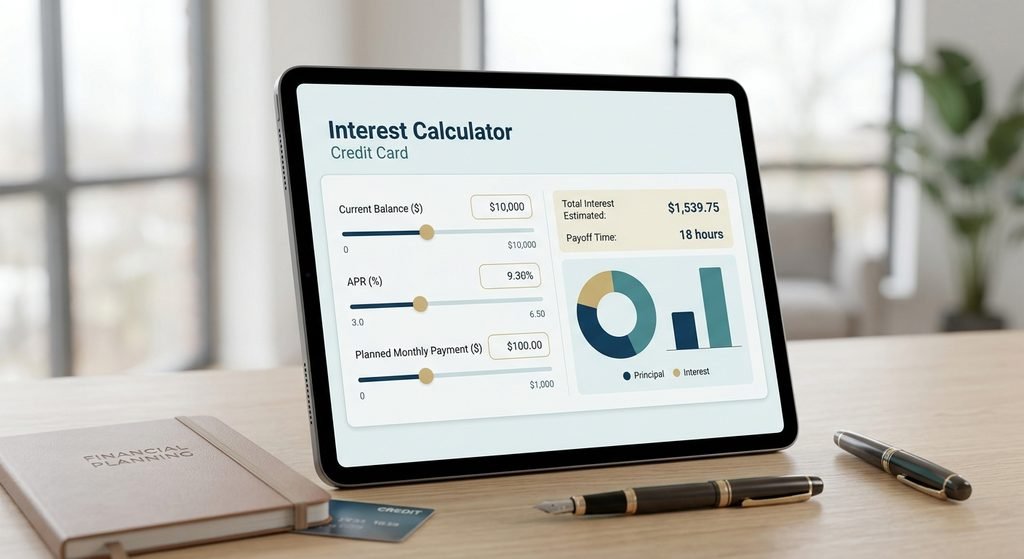
A Interest calculator credit card can compare different payment amounts. For example, you might compare:
- Minimum required payment
- $100 per month
- $200 per month
- $300 per month
The larger payment does not automatically eliminate interest, but it generally reduces the outstanding balance faster when no additional debt is added.
4. New Purchases
If you continue using the credit card while trying to repay an existing balance, the calculation becomes more complicated.
A Interest calculator credit card based only on an existing balance may not reflect the effect of new purchases, transaction timing, or the card’s grace period rules.
5. Promotional Rates
A balance transfer or promotional purchase offer may have a temporary interest rate that differs from the standard APR.
The Interest calculator credit card should account for the promotional period if that feature is relevant.
What Is APR on a Credit Card?
APR is the annual percentage rate associated with borrowing on the credit card.
If a credit card has a 24% APR, that does not necessarily mean you will be charged exactly 24% of your statement balance once per year. Credit card interest is generally calculated according to the issuer’s stated periodic method and account terms.
APR is useful for comparing borrowing costs, but you should also look at fees, promotional periods, transaction specific rates, and other terms.
For example, two cards could have similar APRs but different fees or promotional conditions. Looking at APR alone may therefore provide an incomplete picture.
What Is the Difference Between APR and Interest Rate?
APR and interest rate are related but should not automatically be treated as identical in every financial product.
For a credit card, the purchase APR is the rate commonly used to determine interest on eligible purchase balances when interest applies. A card agreement may also list separate APRs for cash advances and balance transfers.
The important point is to use the rate that applies to the transaction you are calculating.
Does a Credit Card Have a Grace Period?
Many credit cards offer a grace period for purchases, but the exact conditions depend on the card agreement.
A grace period can allow you to avoid interest on eligible new purchases when you meet the required payment conditions, often by paying the statement balance in full by the due date.
However, grace period rules can differ. Cash advances and some balance transfers may be treated differently, and carrying an existing balance can affect how new purchases are handled.
Do not assume that every credit card transaction receives the same interest treatment.
How Is Interest Calculator Credit Card Usually?
Interest Calculator Credit card issuers can use a method described in the cardholder agreement. A common approach involves a daily periodic rate and an average daily balance.
A simplified example might look like this:
Suppose:
- Balance: $1,000
- APR: 24%
- Daily periodic rate: 24% ÷ 365
- Balance remains approximately the same throughout a hypothetical 30 day billing cycle
The estimated interest can be approximated by:
$1,000 × (0.24 ÷ 365) × 30
This produces an estimate of approximately $19.73.
This is only a simplified example. Actual credit card interest can differ because balances can change during the billing cycle, payments can post on different dates, and the issuer may use specific contractual rules.
Can You Interest Calculator Credit Card Without a Calculator?
Yes. A simple estimate can be made manually.
For a basic approximation:
Interest ≈ Balance × APR × Time
For a one month estimate:
Interest ≈ Balance × (APR ÷ 12)
For a daily approximation:
Interest ≈ Balance × (APR ÷ 365) × Number of days
These formulas are useful for understanding the concept, but they should not be treated as a replacement for your issuer’s actual calculation.
For a precise account level figure, review your statement and card agreement.
How Much Interest Will I Pay on a Credit Card?
The amount of interest you pay depends on several factors rather than the balance alone.
The most important factors include:
- Outstanding balance
- Applicable APR
- Average balance during the billing period
- Payment amount
- Payment timing
- New purchases
- Cash advances
- Balance transfers
- Fees
- Promotional rates
- Grace period eligibility
- Issuer’s interest calculation method
A high balance with a high APR can produce substantially more interest than a smaller balance with a lower APR. Likewise, paying more toward principal can reduce the balance on which future interest is calculated.
Why Minimum Payments Can Take Longer
Interest Calculator Credit card statements commonly specify a minimum payment. Paying at least that amount may keep the account current under the applicable agreement, but making only the minimum can result in a longer repayment period and greater total interest.
Consider a hypothetical $3,000 balance. If the applicable APR is relatively high and the cardholder makes only small payments while continuing to add purchases, the balance may decline slowly.
A repayment calculator can show the difference between a minimum payment and a larger fixed payment.
This is one reason a credit card payoff calculator can be useful alongside an interest calculator.
Interest Calculator Credit Card vs. Credit Card Payoff Calculator
These tools are related but answer different questions.
| Tool | Main purpose |
|---|---|
| Interest Calculator credit Card | Estimates interest charges |
| Credit card payoff calculator | Estimates repayment time and total interest |
| Minimum payment calculator | Estimates the effect of minimum payments |
| Credit card payment calculator | Helps estimate payments needed for a target payoff period |
An Interest calculator credit card is useful when you want to understand the cost of carrying a balance. A payoff calculator is more useful when you want to create a repayment timeline.
Using both can give you a clearer picture of the total cost.
How to Use an Interest Calculator Credit Card Tool
A practical process is straightforward.
Step 1: Check Your Current Balance
Look at your latest statement or account information and identify the balance relevant to your calculation.
Step 2: Find the Applicable APR
Check the card’s terms or statement for the APR that applies to your balance.
Do not automatically use the purchase APR if you are calculating a cash advance or balance transfer.
Step 3: Enter Your Payment Amount
Enter the amount you realistically expect to pay each month.
If you want to compare strategies, run the calculation several times using different payment amounts.
Step 4: Account for New Spending
If you intend to continue using the card, understand that a simple payoff estimate may become inaccurate.
For the clearest debt repayment calculation, consider an example in which no additional purchases are made.
Step 5: Compare the Results
Look at estimated interest, total repayment, and repayment time.
This can show how changes in payment amount affect the overall cost.
What Happens If You Pay More Than the Minimum?
Paying more than the minimum can reduce the outstanding balance faster, assuming other factors remain similar.
For example, suppose a hypothetical cardholder has a $2,400 balance and decides to increase a monthly payment from $100 to $200.
The larger payment means more money is directed toward reducing the balance after applicable interest and charges. As the balance falls, future interest can also decrease.
The exact savings depend on the card’s APR, calculation method, payment timing, fees, and whether new purchases are added.
Common Mistakes When Interest Calculator Credit Card
Using the Credit Limit Instead of the Balance
The credit limit is the maximum amount available under the account terms. It is not automatically the amount on which interest is calculated.
Use the relevant outstanding balance.
Assuming APR ÷ 12 Always Gives the Exact Monthly Charge
Dividing APR by 12 is useful for a simple estimate, but an issuer may calculate interest using a daily periodic rate or another method.
Use the card agreement for account specific calculations.
Ignoring Different APRs
A card may have separate rates for purchases, cash advances, and balance transfers.
Using one APR for every transaction can produce an inaccurate estimate.
Forgetting New Purchases
A payoff calculation can become unrealistic if the cardholder continues adding new purchases.
If your goal is to estimate debt payoff, separating existing debt from future spending can make the calculation easier to understand.
Treating the Calculator Result as the Statement Amount
An online calculator provides an estimate unless it precisely replicates the issuer’s methodology and account activity.
Your statement is the more relevant source for the actual interest charged to your account.
How Can You Reduce Credit Card Interest Costs?
There are several general strategies that may reduce interest costs, although their suitability depends on individual circumstances.
Paying the statement balance in full when possible can help avoid interest on eligible purchases when the card’s terms provide a grace period and its requirements are satisfied.
If you already carry a balance, making larger payments can reduce the outstanding balance more quickly.
Avoiding unnecessary new purchases while repaying existing debt can also prevent the balance from growing.
Some consumers may consider a lower interest card or a balance transfer offer. However, these options can involve fees, promotional periods, eligibility requirements, and other conditions. A lower promotional rate does not necessarily mean the overall transaction will cost less.
What Should You Compare Before Choosing a Credit Card?
If you are considering a new credit card, do not compare cards using APR alone.
Review:
- Purchase APR
- Cash advance APR
- Balance transfer APR
- Annual fee
- Balance transfer fee
- Cash advance fee
- Foreign transaction fees where relevant
- Promotional APR period
- Grace period terms
- Late payment consequences
- Credit requirements
- Rewards and benefits
- Other account terms
The cheapest option for one person may not be the cheapest option for another because spending patterns and repayment habits differ.
Interest Calculator Credit Card and Cash Advances
Cash advances often have different terms from ordinary purchases.
Depending on the card agreement, a cash advance may have a separate APR and fees, and interest may begin accruing differently from ordinary purchases.
For this reason, do not use a purchase interest calculation to estimate a cash advance unless the applicable terms are the same.
Always check the card’s current agreement for transaction specific conditions.
Credit Card Balance Transfers and Interest
A balance transfer allows eligible debt to be moved from one credit card or account to another under the receiving card’s terms.
A promotional balance transfer APR can sometimes be lower than the standard APR, but the offer may have a limited duration and may include a balance transfer fee.
A calculator can help compare the estimated cost of keeping the balance under the existing card with the cost under the new arrangement.
However, the comparison should include applicable fees and the promotional period rather than focusing only on the advertised interest rate.
When Should You Trust a Interest Calculator Credit Card?
A Interest calculator credit card is particularly useful for planning and comparison.
It can help you understand:
- Approximate interest costs
- Potential repayment periods
- Effects of different payment amounts
- Effects of different APR assumptions
- How additional borrowing changes repayment
- Potential differences between repayment strategies
For an exact charge, however, rely on your credit card statement and the terms provided by the issuer.
Current rates, fees, promotional offers, and account rules can change, so verify the latest information directly with the relevant financial institution.
Important Questions to Ask Before Using the Interest Calculator Credit Card
Before entering numbers, ask:
- What is my current balance?
- Which APR applies to that balance?
- Is the balance from purchases, transfers, cash advances, or multiple transaction types?
- Does my card use a daily periodic rate?
- Is there a grace period?
- Am I adding new purchases?
- What payment amount can I realistically maintain?
- Are there fees that should be included?
- Is there a promotional rate?
- Am I trying to estimate one month’s interest or the entire payoff period?
Answering these questions makes the result more useful.
Frequently Asked Questions
How do I interest calculator credit card?
A simple estimate can be calculated by multiplying the balance by the applicable periodic interest rate. For a basic monthly estimate, divide the APR by 12 and multiply it by the balance. Actual issuer calculations may use daily balances and specific account terms.
What is a good Interest calculator credit card ?
A useful Interest calculator calculator credit card should allow you to enter the balance, APR, payment amount, and repayment assumptions. It should clearly explain that the result is an estimate and that actual charges depend on the card issuer’s terms.
How much interest will I pay on a $1,000 credit card balance?
It depends on the APR, calculation method, balance changes, and payment timing. For a simplified example, a $1,000 balance at a 24% annual rate would produce about $20 of interest for one month using a simple 2% monthly assumption, but the actual issuer charge may differ.
Does paying the minimum payment increase Interest calculator credit card?
Making only the minimum payment can keep a balance outstanding for longer, which can increase the total interest paid over time. The exact result depends on the card’s terms, APR, balance, and future payments or purchases.
Can I Interest calculator credit card interest by hand?
Yes. You can estimate interest using the balance, APR, and applicable period. However, a manual calculation may not reproduce the exact amount charged by the issuer because account specific calculations can involve daily balances, payment dates, fees, and different transaction types.
Does APR determine the total cost of a credit card?
No. APR is important, but total cost can also depend on annual fees, transaction fees, promotional terms, balance transfer fees, cash advance charges, and other conditions.
Does paying my credit card in full avoid interest?
For many cards, paying the statement balance in full by the due date can allow eligible purchases to avoid interest when the account’s grace period requirements are met. The exact rules depend on the card agreement, and transactions such as cash advances may be treated differently.
Can a interscredit card calculator tell me my exact interest charge?
Not necessarily. An online calculator usually provides an estimate. Your actual interest charge is determined by your issuer using the calculation method and account activity specified in your card agreement.
Recommended External Source Types
For authoritative and current information, readers should verify credit card terms through:
Central banks or recognized financial authorities where applicable
The official credit card issuer
The relevant financial regulator
Government consumer finance agencies
Official cardholder agreements and fee disclosures.
Final Thoughts
An Interest calculator credit card tool can make borrowing costs much easier to understand. By entering the balance, applicable APR, payment amount, and other relevant assumptions, you can estimate interest and see how repayment choices may affect the total cost.
The most important point is to treat the Interest calculator credit card as a planning tool rather than a substitute for your credit card statement. Actual interest can depend on daily balances, payment dates, transaction types, promotional rates, fees, grace period rules, and the issuer’s contractual calculation method.
If you are comparing repayment strategies, look beyond the monthly payment. Consider the total interest, repayment period, applicable fees, and whether you can consistently maintain the payment without creating additional debt.
For current APRs, fees, promotional offers, and account specific rules, verify the information directly with the relevant card issuer or financial institution before making a financial decision.
Related Wealth Articles

Whole Life Insurance: How It Works, Benefits, Costs and Risks
Whole life insurance is a type of permanent life insurance designed to provide coverage for the insured person’s…

Oscar Health Insurance: Plans, Costs, Coverage and Enrollment Guide
Choosing health insurance can be difficult because the lowest monthly premium is not always the lowest overall cost.…