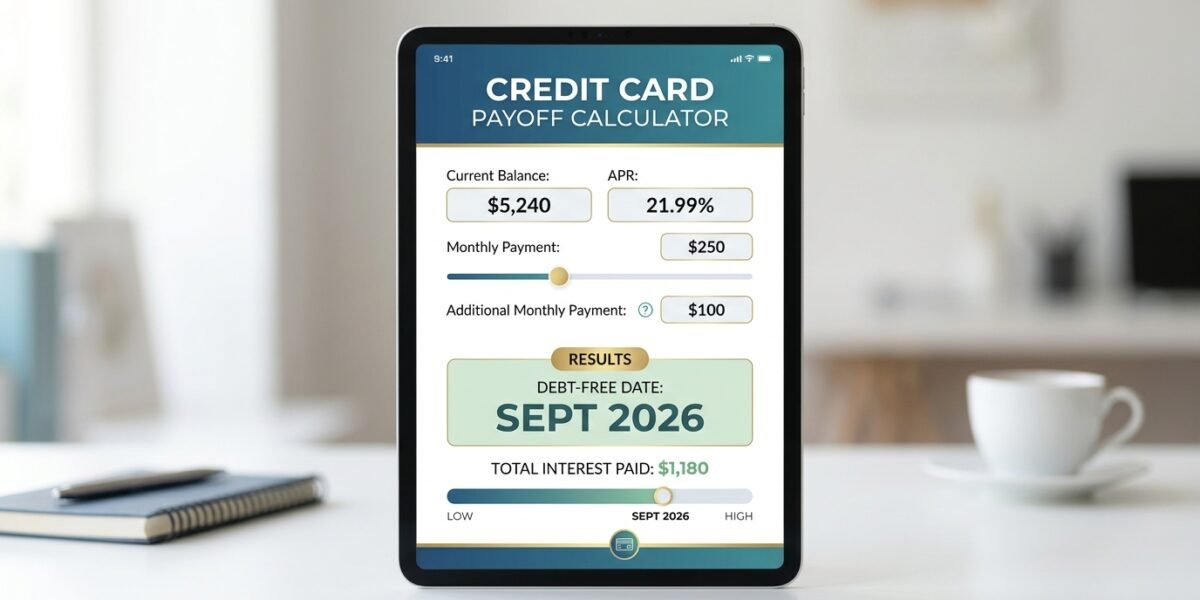
Credit Card Payoff Calculator: Calculate Your Debt Free Date
A credit card payoff calculator helps you estimate how long it may take to pay off a credit card balance and how much interest you could pay along the way. By entering information such as your current balance, APR, minimum payment, and planned monthly payment, you can turn a general debt goal into a clearer repayment plan.
This can be especially useful when a balance has been carried from month to month. Credit card interest can make debt harder to eliminate because part of each payment may go toward interest rather than reducing the principal balance.
A payoff calculator does not predict the exact future balance of a credit card because actual results can depend on factors such as new purchases, fees, payment timing, changing APRs, and the way the card issuer calculates interest. However, it can provide a useful estimate under stated assumptions.
This guide explains how a credit card payoff calculator works, what information you need, how to interpret the results, how extra payments can affect repayment, common mistakes to avoid, and how to build a realistic credit card debt payoff plan.

What Is a Credit Card Payoff Calculator?
A credit card payoff calculator is a financial planning tool that estimates the time and payments required to eliminate a credit card balance.
Most calculators use several basic inputs:
- Current credit card balance
- Annual percentage rate (APR)
- Minimum payment or planned monthly payment
- Additional monthly payment, if applicable
- Sometimes the desired payoff period
The credit card payoff calculator then estimates how the balance may decline over time and how much interest may accumulate before the balance reaches zero.
For example, suppose someone has a hypothetical credit card balance of $5,000 and an APR of 24%. If they make only relatively small payments, the debt may take considerably longer to eliminate than if they consistently make larger payments.
The example is hypothetical. Actual repayment results depend on the card’s terms, payment schedule, interest calculation method, fees, and whether additional purchases are made.
How Does a Credit Card Payoff Calculator Work?
A credit card payoff calculator generally applies the interest rate to the outstanding balance and then subtracts the payment made during each repayment period.
A simplified monthly calculation can be represented as:
Monthly interest rate = Annual APR ÷ 12
Estimated interest = Outstanding balance × Monthly interest rate
Estimated principal reduction = Monthly payment − Estimated interest
The process is repeated for each payment period until the estimated balance reaches zero.
Real credit card calculations can be more complicated. Credit card issuers may calculate interest using methods involving average daily balances or daily periodic rates rather than simply applying the APR once per month.
That is why a calculator should be treated as an estimate rather than an exact statement of what a card issuer will charge.
What Information Do You Need for a Credit Card Payoff Calculator?
The more accurate the inputs, the more useful the estimate is likely to be.
Current Credit Card Balance
Enter the amount currently owed on the card. If you have several cards, you can calculate each balance separately before creating an overall debt repayment plan.
Check your latest statement rather than relying on an old balance.
Credit Card APR
APR stands for annual percentage rate. For payoff calculations, the APR is important because it affects how quickly interest accumulates.
If your credit card has different APRs for purchases, cash advances, or balance transfers, check which rate applies to the balance being calculated.
Monthly Payment
Enter the amount you realistically expect to pay every month.
Using a payment amount that is larger than your actual budget can make a calculator produce an attractive but unrealistic payoff date.
Additional Monthly Payment
Some credit card payoff calculators allow you to test what happens when you pay more than the minimum.
For example, you might compare a minimum payment scenario with a fixed payment that is $50, $100, or $200 higher each month.
New Purchases
This is an important factor that simple calculators may not account for.
If you continue using the credit card while trying to pay it off, new purchases can increase the balance and extend the repayment period.
For a straightforward payoff estimate, many people calculate repayment assuming no additional purchases are made.
Why Is Credit Card APR Important?
The APR is one of the most important variables in a credit card payoff calculator.
A higher APR generally means more interest can accumulate while a balance remains unpaid. A lower APR can reduce the interest component of payments, although the actual outcome still depends on the balance, payment amount, and other card terms.
Consider a hypothetical $4,000 balance. If two cards have different APRs but the same balance and repayment amount, the card with the higher applicable interest rate would generally accumulate interest at a faster rate.
This is one reason borrowers should understand the APR shown in their card agreement and statements rather than looking only at the minimum payment.
Minimum Payment vs. Fixed Monthly Payment
One of the most useful comparisons in a credit card payoff calculator is the difference between making minimum payments and making a fixed monthly payment.
A minimum payment is generally the smallest amount the card issuer requires you to pay by the due date under the card’s terms. The exact calculation varies by issuer and card agreement.
Paying only the minimum can result in a long repayment period, particularly when the balance is large relative to the payment and the APR is high.
A fixed payment strategy works differently. Instead of simply paying whatever minimum amount is required, you choose a specific amount that fits your budget and continue making that payment consistently.
For example, a hypothetical borrower could compare:
| Repayment approach | Main purpose |
|---|---|
| Minimum payment | Meet the required payment |
| Fixed monthly payment | Create a predictable repayment plan |
| Minimum + extra payment | Accelerate debt reduction |
| Larger periodic payment | Reduce principal more quickly when affordable |
The right payment amount depends on the person’s income, expenses, other debts, emergency savings, and financial obligations.
How Much Should You Pay on a Credit Card Payoff Calculator?
There is no single payment amount that is suitable for everyone.
A useful starting point is to understand the minimum payment required by the card issuer and then determine whether your budget allows you to consistently pay more.
Before choosing an aggressive payment amount, consider essential expenses and other financial obligations. A repayment plan that leaves no money for necessary expenses or creates a need to borrow again may not be sustainable.
A practical approach is to choose a payment that is:
- Above the minimum when financially possible
- Consistent from month to month
- Compatible with your essential expenses
- Sustainable alongside other debt obligations
- Based on a realistic monthly budget
A credit card payoff calculator can help you test different payment levels before committing to a specific target.
Credit Card Payoff Calculator Example
Consider a hypothetical borrower with:
- Credit card balance: $6,000
- APR: 24%
- New purchases: $0
- Monthly payment: $300
The borrower could enter these assumptions into a payoff calculator to estimate the repayment period and total interest.
They could then run another scenario with a $400 monthly payment.
The purpose of the comparison is not to predict an exact future statement balance. Instead, it helps show how changing one variable, the monthly payment, can affect the estimated repayment timeline.
The borrower could also test a third scenario, such as $500 per month, provided that amount is realistic for their budget.
This type of scenario analysis can make a debt repayment goal easier to understand.
How Extra Payments Can Affect Credit Card Debt
Extra payments can reduce the outstanding balance faster, assuming the money is actually applied toward the balance and no new debt is added.
When the balance falls, future interest charges may also be calculated on a smaller amount, depending on the card’s interest calculation method.
For example, imagine a borrower normally pays $300 per month but receives additional income and decides to make a one time extra payment.
A credit card payoff calculator can be used to compare the estimated result before and after the additional payment.
However, people should not assume that every extra payment produces the same result. Payment timing, interest calculation, fees, new purchases, and the card’s terms can all affect the actual outcome.
What Happens If You Keep Using the Credit Card Payoff Calculator?
A credit card payoff Calculator plan becomes harder to follow if new purchases continually increase the balance.
Suppose a borrower pays $400 toward a card but makes $350 of new purchases during the same period. The net reduction in the balance may be much smaller than expected, before considering interest and fees.
For this reason, a credit card payoff calculator is most useful when the assumptions match the intended behavior.
If the goal is to eliminate an existing balance, consider calculating the repayment plan using a no new purchases assumption and then separately budgeting for necessary expenses.
Credit Card Payoff Calculator vs. Minimum Payment
The main difference is the repayment objective.
A minimum payment is designed to satisfy the card’s required payment terms. A debt payoff strategy is designed to eliminate the balance within a planned period.
For someone carrying a balance, it can be useful to calculate both scenarios.
Ask:
- What happens if I make only the required payment?
- What happens if I pay a fixed amount every month?
- How much could the estimated interest change?
- Can I maintain the larger payment without disrupting essential expenses?
- What happens if I make occasional additional payments?
These questions turn a calculator from a simple number generator into a budgeting tool.
How to Create a Credit Card Debt Payoff Plan
A credit card payoff calculator is only one part of debt repayment. A practical plan should also account for your complete financial situation.
1. List Every Credit Card Balance
Record the balance, APR, minimum payment, and due date for each card.
This creates a complete picture of the debt rather than focusing on one account.
2. Stop Unnecessary New Debt
If possible, avoid adding discretionary purchases to a card you are actively trying to pay off.
Continuing to increase the balance can undermine the repayment plan.
3. Choose a Repayment Strategy
Two common approaches are the debt avalanche and debt snowball methods.
The debt avalanche generally prioritizes debts with higher interest rates first while making required payments on other debts.
The debt snowball generally prioritizes the smallest balance first, regardless of interest rate.
Both approaches require consistent payments. The choice can depend on a person’s financial circumstances and behavioral preferences.
4. Use a Realistic Monthly Target
Choose a payment amount based on your actual budget rather than an idealized number.
If the calculator says you need $700 per month to reach a particular target but your budget cannot support that payment, adjust the goal.
5. Recalculate When Circumstances Change
Income, expenses, interest rates, balances, and financial priorities can change.
Recalculating periodically can help you understand whether the original payoff estimate still matches your situation.
Credit Card Payoff Calculator vs. Balance Transfer
A balance transfer involves moving eligible debt from one credit card or account to another under the terms offered by the new provider.
A balance transfer calculator and a credit card payoff calculator answer different questions.
A credit card payoff calculator focuses primarily on how long it may take to eliminate an existing balance under a particular payment and interest assumption.
A balance transfer analysis should consider additional factors such as:
- Promotional APR period
- Balance transfer fee
- Standard APR after the promotional period
- Transfer eligibility
- Credit limit
- Payment requirements
- What happens if the balance remains after the promotional period
A promotional rate should not automatically be treated as a permanent interest rate.
Always check the current terms directly with the card issuer before transferring debt.
Credit Card Payoff Calculator vs. Personal Loan
Another potential debt management option is replacing eligible credit card debt with a personal loan.
This requires more than comparing the advertised interest rate.
Consider the personal loan’s APR, fees, repayment period, monthly payment, total repayment amount, and whether the loan changes your overall financial position.
A lower monthly payment does not necessarily mean lower total borrowing costs. A longer repayment period can sometimes reduce the monthly payment while increasing the total interest paid.
A credit card payoff calculator can therefore be useful for comparison, but it should be combined with a full review of the terms.
Common Credit Card Payoff Calculator Mistakes
Focusing Only on the Monthly Payment
A low monthly payment can look affordable, but it may extend the repayment period.
Look at the estimated total interest and payoff date as well as the monthly payment.
Ignoring the APR
Two cards with similar balances can have very different repayment costs when their applicable APRs differ.
Always include the correct interest rate when using a calculator.
Continuing to Add New Purchases
A repayment calculation based on a declining balance becomes less useful when new purchases continually increase the debt.
Track new spending separately.
Using Unrealistic Payment Amounts
A calculator can produce an attractive payoff date when you enter a payment that you cannot actually afford.
Use your real budget.
Forgetting Fees
Late fees, annual fees, balance transfer fees, cash advance fees, and other charges may affect the actual cost of credit.
Check your card agreement and latest statements for applicable charges.
Treating the Calculator as an Exact Statement
A calculator provides an estimate based on its assumptions.
Your card issuer’s statement and account terms determine the actual amount owed.
What If You Have Multiple Credit Cards?
If you have several credit cards, calculate each balance individually and then look at the entire debt picture.
For each card, record:
- Current balance
- APR
- Minimum payment
- Due date
- Applicable fees
- Promotional rates or expiration dates
You can then compare repayment strategies.
For example, a borrower might choose to direct additional money toward the highest APR balance while continuing required payments on other cards. Another borrower may prefer to eliminate a smaller balance first.
The important point is to make required payments on all accounts according to their terms while directing any additional repayment toward the chosen priority.
Can a Credit Card Payoff Calculator Improve Your Credit Score?
A credit card payoff calculator does not directly improve a credit score. It is simply a planning tool.
Paying down credit card balances can affect credit related factors, but credit scoring models use multiple pieces of information and different models can evaluate information differently.
Therefore, nobody should use a payoff calculator with the expectation of a guaranteed credit score increase.
The primary purpose of the calculator is to understand debt repayment, interest costs, and potential payoff timelines.
What Should You Check Before Paying Off a Credit Card?
Before making a large payment, review the account information and your broader financial situation.
Check:
- Current balance
- Current APR
- Minimum payment
- Payment due date
- Pending transactions
- Applicable fees
- Promotional APR expiration dates
- Other high priority financial obligations
- Emergency savings needs
Also make sure the payment is made through the correct payment method and before the required deadline.
If you are considering closing a credit card after paying it off, understand that closing an account can have different implications depending on your credit profile and circumstances. Paying off a card and closing a card are separate decisions.
How Accurate Are Credit Card Payoff Calculator?
Credit Card Payoff Calculator can be useful for estimates, but their accuracy depends on the information entered and the calculation assumptions used.
A calculator may not fully reflect:
- Daily interest calculations
- New purchases
- Variable APR changes
- Fees
- Late payments
- Promotional rates
- Different payment posting dates
- Changes in minimum payment requirements
For this reason, compare the calculator’s assumptions with the terms of your actual credit card.
Use the calculator for planning and use your statements and card agreement for the actual account information.
Questions to Ask Before Choosing a Payoff Strategy
Before selecting a repayment target, consider:
How much can I realistically pay every month?
Am I still using the card for new purchases?
What is the APR on each balance?
Do I have other high interest debts?
Would a larger payment leave enough money for essential expenses?
Do I have an emergency fund or another source of financial resilience?
Are any promotional rates about to expire?
Would changing the debt structure introduce additional fees or risks?
These questions can help prevent a calculator result from becoming disconnected from your real financial situation.
Frequently Asked Questions
What is a credit card payoff calculator?
A credit card payoff calculator estimates how long it may take to eliminate a credit card balance based on factors such as the balance, APR, and monthly payment. It can also estimate interest paid under the calculator’s assumptions.
How do I calculate how long it will take to pay off a credit card?
Enter your current balance, applicable APR, and planned monthly payment into a payoff calculator. The calculator estimates the number of payments required under its assumptions. Actual results may differ because of interest calculations, fees, new purchases, and payment timing.
Is it better to pay the minimum or more than the minimum?
Paying more than the minimum can generally reduce the balance faster and may reduce the amount of interest that accumulates over time. However, the payment amount should be affordable and sustainable within your overall budget.
Does paying off a credit card save interest?
Reducing a credit card balance can reduce the amount on which future interest is calculated, depending on the account’s terms and interest calculation method. Paying the balance in full can prevent additional interest on that balance when the account’s terms allow it, but cardholders should review their agreement and statement for specific details.
Can I pay off a credit card early?
In many cases, a credit card balance can be paid before the projected payoff date. Check the card’s terms for any applicable conditions, and make sure the payment is credited properly to the account.
Should I use a credit card payoff calculator for multiple cards?
Yes. You can calculate each card separately and then compare the balances, APRs, minimum payments, and repayment strategies. This can help you organize a broader credit card debt payoff plan.
Does a credit card payoff calculator include fees?
Not every calculator includes every possible fee. Some tools may allow certain fees to be entered, while others may focus only on balance, APR, and payments. Check the calculator’s assumptions before relying on the result.
Is a credit card payoff calculator the same as a debt repayment calculator?
They are related but not necessarily identical. A credit card payoff calculator is designed specifically around credit card balances and interest, while a broader debt repayment calculator may handle multiple types of debt, including personal loans, student loans, or other obligations.
Authoritative Sources to Check for Current Information
Because credit card terms, consumer protections, fees, and regulatory requirements can change, readers should verify current information with authoritative sources.
Useful source types include:
- Consumer financial regulators
- Government consumer finance agencies
- Official credit card issuer websites
- The cardholder agreement and current billing statement
- Recognized financial education organizations
- Relevant banking or financial regulators
For information about a specific credit card, the issuer’s current terms should take priority over a generic calculator or older article.
Final Thoughts
A credit card payoff calculator can turn an uncertain debt situation into a clearer repayment estimate. By entering your balance, APR, and realistic monthly payment, you can see how different payment levels may affect the estimated payoff timeline and interest cost.
The most useful approach is to treat the calculator as a planning tool rather than an exact prediction. Actual credit card balances can be affected by interest calculations, fees, new purchases, payment timing, and changes to account terms.
For a more realistic plan, start with your current statements, identify the applicable APR and minimum payments, decide how much you can sustainably pay each month, and then use different scenarios to understand the potential impact of additional payments.
Most importantly, a payoff plan should fit your complete financial situation. A credit card payoff calculator can provide the numbers, but your budget, existing obligations, and individual circumstances determine which repayment approach is practical for you.
You may also find boge on below
Cheap Car Insurance Colorado
Related Wealth Articles
Interest Calculator Credit Card: How to Calculate Interest and Payments
An Interest calculator credit card helps you estimate how much interest you may pay on a credit card…

Whole Life Insurance: How It Works, Benefits, Costs and Risks
Whole life insurance is a type of permanent life insurance designed to provide coverage for the insured person’s…
1 Discussion Comment