Revenue vs Profit: What Is the Difference?
When comparing revenue vs profit, the simplest distinction is this: revenue is the money a business generates from selling its products or services, while profit is what remains after the relevant costs and expenses are deducted. A company can have high revenue and still have little profit or even a loss.
Understanding this difference is useful when reading financial statements, evaluating a business, or learning basic accounting. Revenue generally appears near the top of an income statement, while net profit appears after expenses have been deducted. The U.S. Securities and Exchange Commission describes revenue as the value of products sold or services provided and net income as the profit remaining after expenses.
What Is Revenue?
Table of Contents
Revenue is the income a business generates from selling goods or providing services during a particular period. It is often called sales or the top line because it generally appears near the beginning of an income statement.
For example, suppose a business sells 1,000 products for $50 each. Its sales revenue would be $50,000 before considering costs and expenses.
Revenue by itself does not tell you how much money the business actually keeps. A company may generate substantial sales but spend a large amount on inventory, employees, rent, marketing, technology, financing, taxes, and other expenses.
Revenue can therefore show the scale of a company’s sales activity, but it should not be confused with profit. Investor.gov defines revenue as the total amount generated from selling goods and services.
What Is Profit?
Profit is the amount remaining after a business deducts applicable costs and expenses from its revenue. The exact meaning can depend on which type of profit is being discussed.
A basic way to express the concept is:
Profit = Revenue − Costs and Expenses
Profit is often discussed at several levels, including gross profit, operating profit, and net profit.
Net profit, also called net income or net earnings, is the amount left after the expenses included in the income statement have been deducted. Investor.gov defines net income as profit after expenses and taxes have been deducted from revenue.
Revenue vs Profit: The Main Difference
The key difference is what each figure tells you.
| Revenue | Profit |
|---|---|
| Shows money generated from sales or services | Shows what remains after applicable costs and expenses |
| Often called the top line | Net profit is commonly called the bottom line |
| Does not normally account for all business expenses | Reflects deductions for relevant costs and expenses |
| Can be high even when a company loses money | Can be positive or negative |
| Helps indicate sales scale | Helps indicate profitability |
| An income statement connects these figures. Revenue starts the calculation, and expenses are deducted as you move through the statement until the business reaches operating profit and ultimately net income or net loss. |
A Simple Revenue vs Profit Example
Imagine a small online store generates $100,000 in sales during one year.
Its expenses might include:
• $40,000 for products and materials
• $15,000 for employee costs
• $10,000 for advertising
• $8,000 for rent, software, and other operating costs
• $5,000 for interest and other expenses
If the total relevant expenses are $78,000, the business would have $22,000 remaining as profit before considering any additional items that may apply under its accounting method.
The important point is that $100,000 is the revenue vs profit figure, not the amount the owner automatically earns. The $22,000 represents the amount remaining after the listed expenses.
This example also shows why looking at revenue vs profit alone can create a misleading impression of financial performance.
Gross Profit vs Operating Profit vs Net Profit
The word profit can refer to different points in an income statement. Understanding these distinctions makes financial statements much easier to read.
Gross Profit
Gross profit is generally calculated by subtracting the cost of goods sold or equivalent direct costs from revenue.
Gross Profit = revenue vs profit − Cost of Goods Sold
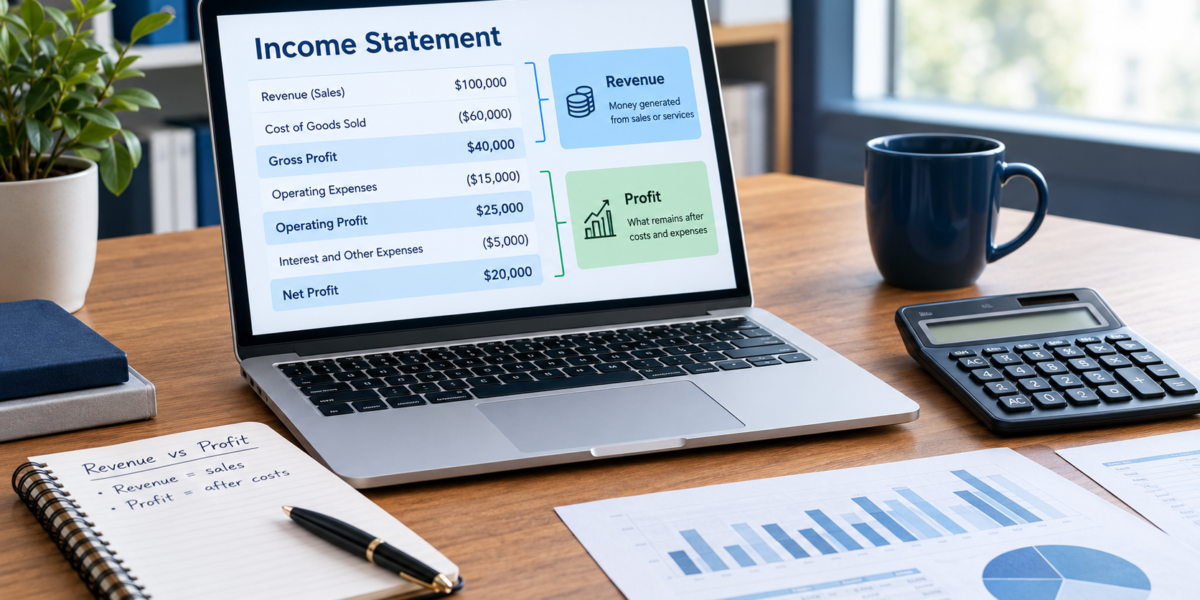
For example, if a company has $100,000 in revenue and $60,000 in cost of goods sold, its gross profit is $40,000.
Gross profit can help show how much remains from sales after the direct costs associated with producing or obtaining the goods or services have been deducted.
Operating Profit
Operating profit measures what remains after operating expenses are deducted from gross profit.
Operating expenses can include costs such as administrative salaries, marketing, rent, and other expenses involved in running the business. The SEC notes that operating expenses include overhead costs that are not directly associated with producing the products or services being sold.
A simplified formula is:
Operating Profit = Gross Profit − Operating Expenses
Operating profit can provide useful information about how effectively the core business is operating before certain items such as interest and income taxes are considered.
Net Profit
Net profit is generally the amount remaining after the applicable expenses, including items such as interest and income taxes, have been accounted for.
A simplified formula is:
Net Profit = Revenue − All Applicable Expenses
The exact presentation can differ between companies and accounting frameworks, so financial statements should be read as a whole rather than relying on a single number.
Can a Company Have High Revenue but Low Profit?
Yes. A company can generate a large amount of revenue while keeping relatively little profit.
For example, Business A might generate $10 million in revenue but have $9.7 million in costs and expenses. Business B might generate $5 million in revenue but have $3.5 million in costs and expenses.
Business A has higher revenue, but Business B may have higher profit.
This is why revenue growth does not automatically mean that a company’s profitability is improving.
A business may increase sales by spending heavily on advertising, offering discounts, expanding its workforce, opening new locations, or increasing production capacity. If those additional costs grow faster than revenue, profit can remain unchanged or decline.
Can a Company Have Profit Without Revenue?
For a normal operating business, revenue from selling goods or services is usually a major source of income, but accounting statements can contain other forms of income or gains.
This is one reason it is better not to treat revenue vs profit as interchangeable terms. The income statement may contain different categories of income, expenses, gains, and losses depending on the business and accounting framework.
For investors and readers of financial statements, the definitions and presentation used in the company’s financial reporting should be considered.
Revenue vs Profit Margin

Revenue and profit are absolute amounts, while a profit margin expresses profit as a percentage of revenue vs profit.
A simplified net profit margin formula is:
Net Profit Margin = Net Profit ÷ Revenue × 100
For example, if a company earns $20,000 in net profit from $100,000 in revenue vs profit:
Net Profit Margin = $20,000 ÷ $100,000 × 100 = 20%
This means the company generated $0.20 of net profit for every $1 of revenue vs profit under the figures used in the example.
Margins can be useful when comparing profitability across periods or, with appropriate context, across businesses of different sizes.
Why Revenue Matters
Revenue provides important information about a company’s ability to generate sales.
When reviewing revenue, readers may consider:
• Whether sales are increasing or decreasing
• Where revenue comes from
• Whether growth is consistent
• Whether revenue depends heavily on one product or customer
• Whether sales growth is accompanied by rising costs
Revenue is particularly useful when considered alongside expenses and profit rather than viewed in isolation.
Why Profit Matters
Profit shows whether revenue is sufficient to cover the costs and expenses associated with the business.
Profit can help readers assess:
• Whether the business is generating a surplus
• How efficiently revenue vs profit is being converted into earnings
• Whether costs are consuming a large portion of sales
• Whether profitability is improving or declining
• How much remains after the applicable expenses
However, profit should not be treated as the same thing as cash. A company can report accounting profit while its cash position changes for other reasons. The SEC explains that cash flow statements provide information about cash inflows and outflows and are related to, but not equivalent to, net income.
Revenue vs Profit When Evaluating a Business
If you are evaluating a company, looking at only revenue vs profit or only can give an incomplete picture.
A better approach is to consider several financial measures together.
Start with revenue vs profit to understand the company’s sales activity. Then examine gross profit and operating profit to understand the costs of producing goods or services and running the business. Finally, look at net profit to understand what remains after the relevant expenses.
It can also be useful to examine profit margins and cash flow. No single financial statement or financial metric provides the complete picture of a company’s financial condition.
Common Mistakes About Revenue and Profit
Mistake 1: Assuming Revenue Is Profit
Revenue is not the same as money available to the owner. Expenses must be considered before determining profit.
Mistake 2: Assuming Higher revenue vs profit Always Means a Better Business
Higher sales can be accompanied by higher costs. revenue vs profit growth is more meaningful when profitability and cash generation are considered as well.
Mistake 3: Confusing Profit With Cash
Accounting profit and cash flow are different measures. A profitable company can still face cash flow challenges.
Mistake 4: Looking at Only One Period
One year’s revenue or profit does not always explain the direction of a business. Comparing multiple periods can provide more useful context.
Mistake 5: Treating Gross Profit as Net Profit
Gross profit is calculated earlier in the income statement and does not include every expense. Net profit comes later after additional expenses have been accounted for.
Which Is More Important: Revenue or Profit?
Neither figure is universally more important. They answer different questions.
Revenue helps answer:
“How much did the business generate from its sales?”
Profit helps answer:
“How much remained after the relevant costs and expenses?”
A company needs sufficient revenue to support its operations, but revenue without sustainable profitability may not produce a healthy business. At the same time, a company with lower revenue can potentially be profitable if it controls its costs effectively.
For a complete analysis, revenue, profit, margins, expenses, and cash flow should be considered together.
Revenue vs Profit in Financial Statements
The income statement is the main financial statement used to examine revenue, expenses, and profit over a specific period.
A simplified income statement can look like this:
| Income Statement Item | Example Amount |
|---|---|
| Revenue | $100,000 |
| Cost of goods sold | $60,000 |
| Gross profit | $40,000 |
| Operating expenses | $15,000 |
| Operating profit | $25,000 |
| Other expenses and taxes | $5,000 |
| Net profit | $20,000 |
| The exact structure varies by company and accounting requirements. The SEC’s educational material shows revenue, cost of goods sold, gross profit, operating expenses, operating profit, interest, taxes, and net income as successive components of an income statement. |
FAQ SECTION
What is the difference between revenue and profit?
Revenue is the amount generated from selling goods or services, while profit is the amount remaining after applicable costs and expenses are deducted.
Is revenue higher than profit?
Usually, yes, because expenses are deducted from revenue to calculate profit. However, a business can have a loss instead of a profit when its expenses exceed its revenue.
What are the three types of profit?
The commonly discussed levels are gross profit, operating profit, and net profit. They occur at different stages of an income statement and account for different categories of costs and expenses.
Is net income the same as net profit?
In many financial contexts, net income and net profit are used to describe the amount remaining after applicable expenses and taxes have been deducted. Investor.gov uses net income to describe profit after expenses and taxes.
Can a company have high revenue but low profit?
Yes. High operating costs, production costs, marketing expenses, interest, taxes, and other expenses can reduce the amount of profit even when revenue is high.
Is profit the same as cash flow?
No. Profit and cash flow are different financial measures. An income statement reports revenue, expenses, and profit, while a cash flow statement tracks cash inflows and outflows.
Why is revenue called the top line?
Revenue is commonly called the top line because it generally appears near the top of an income statement before costs and expenses are deducted.
Final Takeaway
Revenue and profit are closely connected, but they are not the same thing. Revenue measures what a business generates from selling its goods or services, while profit measures what remains after relevant costs and expenses are deducted.
When comparing businesses or reading financial statements, do not stop at revenue. Look at gross profit, operating profit, net profit, profit margins, expenses, and cash flow to develop a more complete understanding of financial performance.
For investors or business owners, the most useful question is usually not simply whether revenue is growing, but whether the business is turning that revenue into sustainable profitability while maintaining an appropriate financial position.
You may also find blog on below
Globe Life Insurance
Related Wealth Articles

American First Finance: A Complete Guide to Payment Options, Costs, and Customer Considerations
What Is American First Finance? American First Finance is a consumer financing company that offers payment solutions through…

Capital One Customer Service 24/7 Phone Number: How to Get Help
Finding the Capital One customer service 24/7 phone number can help you determine how to contact the company…
1 Discussion Comment