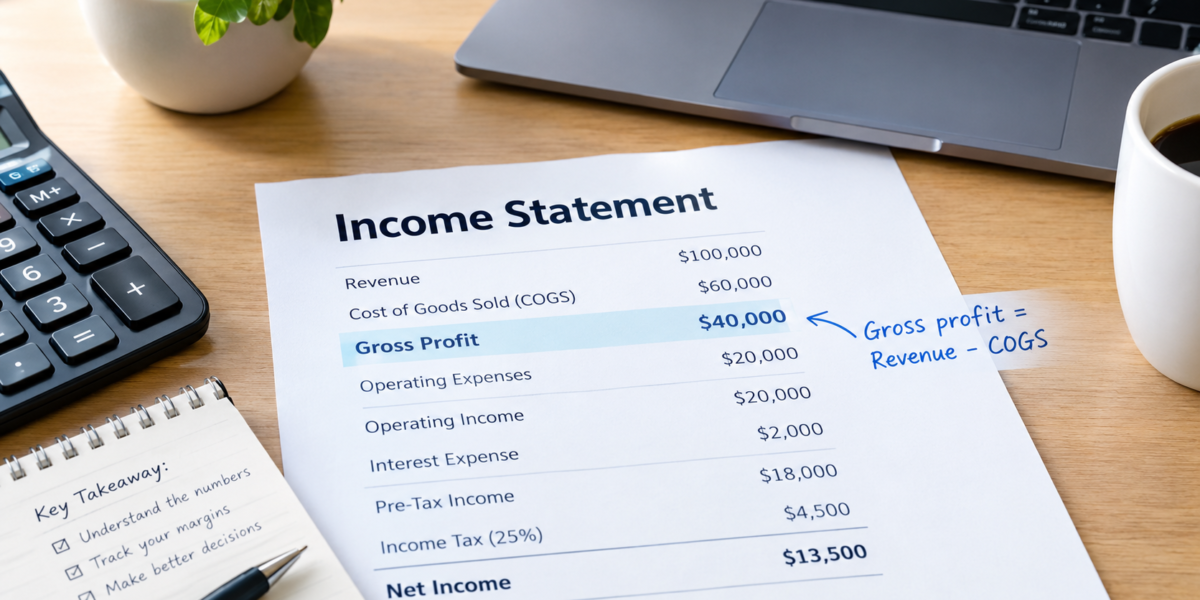
How to Find Gross Profit on an Income Statement
To find gross profit on an income statement, subtract cost of goods sold from net sales.
Gross Profit = Net Sales − Cost of Goods Sold
For example, if a company reports $500,000 in net sales and $320,000 in cost of goods sold, its find gross profit is $180,000.
Gross Profit = $500,000 − $320,000 = $180,000
Gross profit is the amount left from sales after accounting for the direct costs associated with the goods or services sold. On many income statements, it appears before operating expenses such as selling, general and administrative expenses. The U.S. Securities and Exchange Commission explains that income statements generally move from revenue to costs of sales and then to gross profit before other operating expenses are deducted.
Table of Contents
What Is Gross Profit?
Gross profit measures how much revenue remains after a business accounts for the cost of producing or obtaining the goods or services it sold.
For businesses that sell products, cost of goods sold, or COGS, generally represents the costs associated with products sold during the reporting period. Depending on the type of business and its accounting practices, these costs can include inventory costs and other direct costs associated with getting products ready for sale.
find Gross profit is different from net profit. find Gross profit is calculated before many operating expenses, interest, taxes, and other expenses are deducted. Net income is calculated later after the relevant expenses, gains, and losses have been considered.
Gross Profit Formula
The basic formula is:
find Gross Profit = Net Sales − Cost of Goods Sold
The two numbers you need are net sales and cost of goods sold.
Net sales generally represent sales after deductions such as returns, allowances, and discounts where applicable. Cost of goods sold represents the costs associated with the products sold during the period.
Example
Suppose an income statement contains these figures:
| Income Statement Item | Amount |
|---|---|
| Net Sales | $750,000 |
| Cost of Goods Sold | $450,000 |
| Gross Profit | $300,000 |
| The calculation is: | |
| $750,000 − $450,000 = $300,000 | |
| Therefore, the company’s gross profit is $300,000. |
Where Is Gross Profit on an Income Statement?
On a traditional multiple step income statement,find gross profit is usually found below net sales and cost of goods sold.
A simplified structure may look like this:
Net Sales: $750,000
Less: Cost of Goods Sold: $450,000
Gross Profit: $300,000
Operating Expenses: $190,000
Operating Income: $110,000
The exact presentation can vary between companies. Some businesses may use terms such as cost of sales, cost of products sold, or cost of revenue rather than cost of goods sold. For service businesses, a company may report direct costs as cost of services.
Step by Step: How to Calculate Gross Profit
Step 1: Find net sales
Start near the top of the income statement and identify the company’s sales or revenue figure.
If the statement shows gross sales followed by returns, allowances, or discounts, determine the applicable net sales amount. Net sales are generally the appropriate revenue figure for calculating gross profit when those deductions apply.
Step 2: Find cost of goods sold
Next, look for cost of goods sold, cost of sales, cost of products sold, or a similar line item.
This represents the costs associated with the goods sold during the reporting period. The exact components depend on the business and its accounting system.
Step 3: Subtract COGS from net sales
Use the formula:
find Gross Profit = Net Sales − Cost of Goods Sold
For example:
Net Sales = $900,000
Cost of Goods Sold = $540,000
Gross Profit = $900,000 − $540,000
Gross Profit = $360,000
Step 4: Check the income statement subtotal
If the company uses a multiple step income statement, gross profit may already be presented as a subtotal. You can still verify it by subtracting COGS from net sales.
If the statement does not show a gross profit subtotal, the same calculation can often be made from the reported sales and cost figures. A single step income statement, for example, may not display gross profit as a separate subtotal even though it can be calculated from the available information.
What If the Income Statement Does Not Show Gross Profit?
Not every income statement presents gross profit as a separate line.
If gross profit is missing, look for:
- Net sales or revenue
- Cost of goods sold, cost of sales, or an equivalent direct cost
Then calculate:
Gross Profit = Net Sales − Direct Cost of Sales
For example, if net sales are $250,000 and cost of sales is $150,000:
$250,000 − $150,000 = $100,000
The estimated gross profit is therefore $100,000, assuming the reported figures are comparable and represent the appropriate period and revenue categories.
Gross Profit vs Gross Margin
Gross profit and gross margin are related but are not the same measurement.
Gross profit is a dollar amount:
Gross Profit = Net Sales − COGS
Gross margin is normally expressed as a percentage:
Gross Margin = Gross Profit ÷ Net Sales × 100
Using the earlier example:
Gross Profit = $300,000
Net Sales = $750,000
Gross Margin = $300,000 ÷ $750,000 × 100
Gross Margin = 40%
So the company generated $300,000 in gross profit and had a 40% gross margin.
The SEC describes gross margin as gross profit expressed as a percentage of revenue, while AccountingCoach similarly distinguishes the gross profit amount from the find gross profit percentage.
Why Gross Profit Matters
Gross profit helps readers understand how much revenue remains after the direct costs associated with sales have been accounted for.
For example, two companies could each generate $1 million in net sales but have different gross profits:
| Company | Net Sales | COGS | Gross Profit | Gross Margin |
|---|---|---|---|---|
| Company A | $1,000,000 | $600,000 | $400,000 | 40% |
| Company B | $1,000,000 | $750,000 | $250,000 | 25% |
| Company A retains more gross profit from the same level of net sales. However, gross profit alone does not determine whether a company is ultimately profitable because operating expenses, interest, taxes, and other items still need to be considered. |
Gross Profit vs Operating Profit vs Net Profit
These measures occur at different stages of the income statement.
| Measure | Basic Calculation | What It Shows |
|---|---|---|
| Gross Profit | Net Sales − COGS | Profit after direct costs |
| Operating Profit | Gross Profit − Operating Expenses | Profit from operations before certain nonoperating items |
| Net Profit | Revenue and gains minus applicable expenses and losses | Profit remaining after the relevant income statement items |
| The SEC describes the income statement as a progression from revenue through costs and operating expenses toward operating income and ultimately net income. | ||
| This distinction matters because a company can have positive gross profit but still report a net loss if its operating, financing, tax, or other expenses are sufficiently large. |
How to Find Gross Profit From a Company’s Annual Report
If you are reviewing a public company’s annual report, start with the consolidated income statement or statement of operations.
Look for the following:
- Revenue or net sales
- Cost of revenue, cost of sales, or cost of goods sold
- find Gross profit, if separately reported
Some companies report several categories of revenue and costs rather than using exactly the same terminology as another company. For example, a business may report product revenue and service revenue with different associated costs.
When comparing companies, make sure the gross profit figures are calculated on a reasonably comparable basis.
How to Calculate Gross Profit for a Retail Business
For a retailer, gross profit is generally based on net sales less the cost of merchandise sold.
For example:
Net Sales = $200,000
Cost of Goods Sold = $125,000
Gross Profit = $75,000
For businesses using a periodic inventory system, cost of goods sold can be calculated using beginning inventory, purchases and related adjustments, and ending inventory. AccountingCoach gives the basic periodic calculation as beginning inventory plus net purchases and freight in, less ending inventory.
The exact accounting treatment can vary, so financial statement users should rely on the company’s reported accounting policies when analyzing a particular business.
How to Calculate Gross Profit for a Manufacturer
A manufacturer’s cost of goods sold can be more complex because production costs may include raw materials, direct labor, and manufacturing overhead associated with the goods produced and sold.
Therefore, you should not automatically assume that COGS is simply the amount paid for raw materials.
The relevant cost calculation depends on the company’s accounting system and production process.
Once the appropriate cost of goods sold has been determined, the find gross profit calculation remains:
Gross Profit = Net Sales − COGS
What About Service Businesses?
Service businesses may not use the term cost of goods sold because they do not sell physical inventory.
Instead, an income statement may present cost of services or cost of revenue. The same basic idea applies when the reported direct costs are subtracted from the relevant revenue to determine find gross profit.
For example:
Service Revenue = $180,000
Direct Cost of Services = $70,000
Gross Profit = $110,000
The exact classification of costs depends on the company’s accounting policies and reporting framework.
Common Mistakes When Finding Gross Profit
Using total expenses instead of COGS
Gross profit is not calculated by subtracting every expense from revenue. Operating expenses such as many administrative and selling expenses are generally deducted after gross profit in a multiple step income statement.
Using gross sales instead of net sales when deductions apply
If the income statement separately reports returns, allowances, or discounts, using gross sales without considering those deductions can produce the wrong gross profit calculation.
Confusing gross profit with net income
Gross profit is an earlier subtotal. Net income comes after additional expenses, gains, losses, and taxes are considered.
Confusing gross profit with gross margin
Gross profit is normally a monetary amount, while gross margin is commonly expressed as a percentage of revenue.
Ignoring the company’s accounting presentation
Different businesses may use terms such as cost of sales, cost of revenue, or cost of services. Always read the labels and accounting policies instead of assuming that every income statement uses identical terminology.
A Quick Gross Profit Calculation
If you only need the basic calculation, use this three step process:
- Find net sales.
- Find cost of goods sold or the equivalent direct cost.
- Subtract the second number from the first.
Example:
Net Sales = $600,000
COGS = $350,000
find Gross Profit = $250,000
If you also want the gross margin:
$250,000 ÷ $600,000 × 100 = 41.67%
This means the company retained approximately 41.67 cents of gross profit for every dollar of net sales, before the expenses that come after gross profit.
Frequently Asked Questions
Is gross profit shown on the income statement?
Often, yes. A multiple step income statement commonly presents gross profit as a subtotal after net sales and cost of goods sold. However, some income statement formats do not show it separately, so it may need to be calculated.
What is the formula for gross profit?
The basic formula is Gross Profit = Net Sales − Cost of Goods Sold.
Is gross profit the same as net profit?
No. Gross profit is calculated after direct costs associated with sales, while net profit is calculated after additional applicable expenses, gains, losses, interest, taxes, and other items.
What is the difference between gross profit and gross margin?
Gross profit is the dollar amount left after subtracting COGS from net sales. Gross margin is commonly the gross profit expressed as a percentage of net sales.
Can I calculate gross profit if it is not listed?
Usually, if the income statement provides net sales and an appropriate cost of sales or COGS figure, you can calculate gross profit yourself.
Does gross profit include operating expenses?
Generally, operating expenses that are deducted after find gross profit are not included in the gross profit calculation. The classification of particular costs can vary by business and accounting framework.
Can a company have gross profit but still lose money?
Yes. A company can have positive gross profit while its operating expenses, interest, taxes, or other costs result in a net loss.
Final Takeaway
To find gross profit on an income statement, identify net sales and subtract the cost of goods sold:
Gross Profit = Net Sales − Cost of Goods Sold
If the income statement already provides a gross profit subtotal, you can use it directly. If it does not, the formula allows you to calculate the amount from the relevant sales and direct cost figures. Remember that find gross profit is not the same as net income, and gross margin is a percentage rather than the dollar amount of gross profit.
For financial analysis, always consider the company’s accounting policies and the definitions used in its financial statements before comparing gross profit figures across businesses.
You may also find blog on below
Revenue vs Profit
Related Wealth Articles

American First Finance: A Complete Guide to Payment Options, Costs, and Customer Considerations
What Is American First Finance? American First Finance is a consumer financing company that offers payment solutions through…

Capital One Customer Service 24/7 Phone Number: How to Get Help
Finding the Capital One customer service 24/7 phone number can help you determine how to contact the company…
1 Discussion Comment