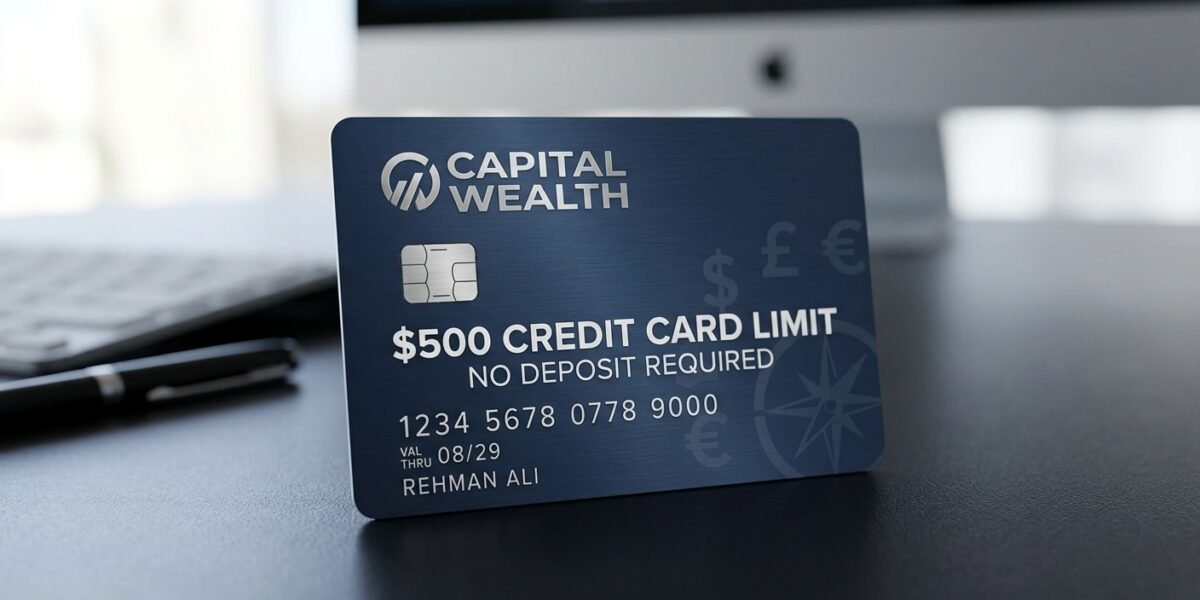
$500 Credit Card Limit No Deposit: How to Qualify
A $500 credit card limit no deposit generally means you are looking for an unsecured credit card that can approve you for a $500 credit card limit no deposit or higher spending limit without requiring a refundable security deposit. This can be especially relevant if you have limited credit history, no established credit, or a lower credit score and do not want to tie up $500 in cash.
The important distinction is that a no deposit credit card is normally unsecured. Unlike a secured credit card, you do not provide cash as collateral when the account is opened. Instead, the issuer evaluates factors such as your credit history, income, existing debt, payment history, and other information before deciding whether to approve your application and what credit limit to offer.
A $500 credit card limit no deposit can be useful for controlled spending and credit building, but approval is never guaranteed. The card’s annual fee, APR, reporting practices, eligibility requirements, and other terms can matter just as much as the initial credit limit.

What Does a $500 Credit Card Limit No Deposit Mean?
A $500 credit card limit no deposit means the issuer has approved a maximum revolving credit line of $500. If the account has no deposit requirement, you are not required to place $500 with the issuer as collateral before using the card.
For example, suppose you receive an unsecured credit card with a $500 credit card limit no deposit . You could make purchases up to the available credit limit, subject to the card’s terms. If you spend $150, your remaining available credit would generally be $350 until you make a payment or otherwise restore available credit.
The $500 is a credit card limit no deposit, not free money. You are responsible for repaying what you borrow, and interest may apply if you carry a balance according to the card’s terms.
This is different from a secured credit card. With a typical secured card, the security deposit often determines the credit limit. For example, a $500 deposit may result in a $500 credit limit. The Consumer Financial Protection Bureau explains that secured cards commonly require a deposit equal to the initial credit line, while responsible use may eventually lead to a higher limit or the return of the deposit.
Can You Get a $500 Credit Card limit No Deposit?
Yes, it is possible to get a credit card with a $500 credit card limit no deposit without making a security deposit, but the issuer decides whether you qualify.
A no deposit card is generally an unsecured credit card. Instead of relying on a security deposit, the card issuer evaluates your creditworthiness and other application information.
There is an important difference between these two situations:
| Card type | Security deposit | How the limit is generally determined |
|---|---|---|
| Unsecured credit card | No | Creditworthiness, income, debt and issuer criteria |
| Secured credit card | Usually required | Often based largely on the deposit |
| Partially secured card | Required, but may cover only part of the limit | Deposit plus issuer’s credit decision |
| Debit or prepaid product | Not a credit card deposit | Your available funds generally determine spending |
A partially secured card is another possibility, although it is less common. These products require a deposit but may provide a credit line larger than the deposit.
If avoiding a deposit is your main priority, an unsecured card is the category to investigate.
Why Would Someone Want a $500 Credit Card Limit No Deposit?
A relatively small credit limit can make sense for someone who wants access to a credit card without taking on a large amount of available credit.
For a person establishing credit, a $500 credit card limit no deposit can provide an opportunity to demonstrate responsible borrowing behavior. The objective should not be to spend the entire $500 credit card limit no deposit every month. Instead, the card can be used for manageable purchases that fit within the person’s budget.
A small limit can also provide a useful spending boundary. If you know that your approved credit line is $500 credit card limit no deposit , you may be less likely to accumulate a large balance than you would with a much higher limit.
However, a $500 credit card limit no deposit can also be restrictive. A single large purchase can consume a significant portion of the available credit, which can affect your credit utilization.
Who Might Look for a $500 Credit Card limit No Deposit?
This type of search is particularly relevant to several groups of consumers.
People With Limited Credit History
Someone who has never used credit may have difficulty qualifying for certain traditional credit cards because there is little information available about their borrowing and repayment behavior.
People Rebuilding Credit
Consumers recovering from previous credit problems may look for cards with lower limits because they can provide a controlled way to manage revolving credit.
People Who Do Not Want a Security Deposit
A secured credit card can require several hundred dollars to be set aside as collateral. Someone who needs to keep their cash available for rent, food, emergency savings, or other expenses may prefer an unsecured card.
People Looking for a Small Credit Line
Not everyone needs a large credit limit. Someone primarily interested in everyday purchases and credit building may consider a $500 credit card limit no deposit sufficient.
How Do No Deposit Credit Cards Work?
The process is similar to applying for other unsecured credit cards.
First, you submit an application to the card issuer. The issuer may ask about your identity, income, housing situation, employment and other financial information.
The issuer then evaluates your application according to its own underwriting criteria. Depending on the application and issuer, your credit report and credit score may be considered.
If approved, the issuer assigns a credit limit. That limit could be $500, higher than $500, or potentially lower if the product permits it.
You then use the card for purchases and make payments according to the billing statement. If you pay the balance in full by the applicable due date, you may avoid interest on purchases when the card’s terms provide a grace period and you meet its requirements.
If you carry a balance, interest may be charged according to the card’s APR.
The key point is that the absence of a deposit does not mean the account is risk free. You are still borrowing money and are legally responsible for repayment.
What Determines Whether You Get a $500 Credit Card Limit No Deposit?
There is no universal formula for receiving exactly a $500 credit card limit no deposit. Each issuer has its own approval and credit limit policies.
Factors that may matter include:
Credit History
Your previous credit accounts and payment behavior can influence an issuer’s assessment of risk.
A history of on time payments can be helpful, while serious delinquencies, defaults, or other negative information can make approval more difficult.
Credit Score
Credit scores are one part of a broader credit profile. A particular score does not guarantee approval because lenders may use different scoring models and additional information.
Income
Income can help an issuer evaluate your ability to make payments. The issuer may consider the income information you provide as part of its application process.
Existing Debt
An applicant with significant existing debt may represent a different level of risk from someone with little outstanding debt, even if both applicants have similar credit scores.
Recent Applications
Applying for several credit products within a short period can result in multiple hard inquiries depending on the applications. Too many applications can also make it more difficult to manage new accounts.
Issuer Specific Requirements
Every credit card issuer establishes its own eligibility requirements, underwriting practices, fees, and credit limit policies. Therefore, a card advertised as suitable for people with limited or damaged credit does not mean every applicant will receive approval.
Can You Get a $500 Credit Card limit No Deposit and Bad Credit?
Possibly, but approval can be more difficult.
Consumers with poor credit may have fewer unsecured card options. Secured credit cards are often designed specifically to reduce the issuer’s risk by requiring collateral, which is why they may be easier to qualify for than some unsecured cards.
If your goal is to avoid a deposit, you may need to compare unsecured cards designed for people with limited, fair, or damaged credit. However, do not judge an offer solely by whether it says easy approval or $500 credit card limit no deposit .
Review the actual terms before applying.
Pay particular attention to the annual fee, APR, foreign transaction fees if relevant, late payment consequences, credit reporting practices, and other account terms.
An unsecured card that does not require a deposit can still be expensive if its fees or interest charges are high.
What If You Have No Credit History?
No credit is not necessarily the same as bad credit.
A person with no credit history may simply lack enough information for traditional scoring models to assess their credit behavior. Some issuers offer products specifically intended for people who are new to credit.
A secured card can be one route because the security deposit reduces the issuer’s risk. Some unsecured cards may also be available to people with limited credit, although approval requirements vary.
If credit building is your objective, check whether the issuer reports account activity to the major consumer credit bureaus. Responsible use of a card can only help build a credit history if the account activity is reported in a way that contributes to your credit file. Experian notes that secured card users should check whether their issuer reports to the major credit bureaus.
How to Use a $500 Credit Card limit No Deposit Responsibly
Getting approved is only the first step. How you manage the account is more important for long term credit health.
Spend Only What You Can Repay
Your credit limit should not become your spending budget.
If you have $500 available but only $200 in your budget for discretionary purchases, spending $500 simply because the issuer allows it can create unnecessary debt.
Pay on Time
Payment history is an important part of credit management. Missing payments can lead to fees, interest, and potentially negative information on your credit reports.
The CFPB recommends paying credit card balances on time and notes that paying the balance in full each month can help avoid finance charges when the card’s terms allow it.
Consider Paying the Statement Balance in Full
If your financial situation allows, paying the statement balance in full each month can help prevent interest from accumulating on purchases when the account’s grace period terms apply.
You do not need to carry interest bearing debt to build credit.
Monitor Your Available Credit
A $500 credit card limit no deposit leaves relatively little room for large purchases.
For example, if your balance reaches $450, you have used 90% of the available credit. Even if you intend to pay the bill later, the reported balance may be relevant to your credit utilization at the time it is reported.
Because credit scoring models and reporting practices can differ, there is no single utilization percentage that guarantees a particular score. Still, keeping balances manageable can be a sensible credit management practice.
$500 Limit Example
Consider this hypothetical example.
You receive an unsecured credit card with a $500 credit card limit no deposit and no security deposit.
During one billing cycle, you make these purchases:
| Purchase | Amount |
|---|---|
| Groceries | $80 |
| Gas | $50 |
| Phone bill | $40 |
| Household items | $30 |
| Total | $200 |
Your total charges are $200, leaving $300 of available credit before considering any other transactions or account adjustments.
If your statement balance is $200 and you pay that amount according to the card’s terms, you have used the card without needing to borrow beyond what you can afford to repay.
This is a hypothetical example, not a recommendation that every consumer should spend a particular amount.
What Are the Advantages of a $500 No Deposit Card?
A no deposit $500 credit card limit no deposit can have several potential advantages.
No Cash Tied Up as Collateral
Unlike a typical secured credit card, an unsecured card does not normally require you to provide a refundable security deposit.
Can Provide Access to Revolving Credit
A credit card can provide a payment method for everyday expenses, subject to the account’s terms and your ability to repay.
May Help Establish Credit
If the issuer reports the account to consumer credit bureaus, responsible use may contribute to your credit history.
Smaller Limit Can Encourage Controlled Spending
A $500 limit naturally restricts how much you can charge at one time.
However, these benefits depend on the actual card and your financial circumstances.
What Are the Disadvantages?
A low limit, no deposit card also has drawbacks.
Limited Purchasing Power
A $500 credit card limit no deposit may not be enough for larger expenses.
High Utilization Can Happen Quickly
A single $300 purchase would use 60% of a $500 credit line.
Interest Can Become Expensive
If you carry balances, the card’s APR can make purchases considerably more expensive over time.
Fees May Reduce the Value
Some cards aimed at consumers with limited or damaged credit may charge annual, monthly, application, or other fees. The exact terms vary by issuer.
Approval Is Not Guaranteed
A card advertised for consumers with poor or limited credit can still have eligibility requirements.
$500 No Deposit Card vs. $500 Secured Credit Card
The biggest difference is where the credit line comes from.
With an unsecured card, the issuer generally provides the credit line based on its assessment of your creditworthiness. No security deposit is normally required.
With a secured card, you provide a refundable security deposit that generally determines or contributes to the credit limit. Experian explains that secured card deposits are typically equal to the credit limit, although some cards may use different structures.
For someone who has the cash available but struggles to qualify for unsecured credit, a secured card may be an alternative.
For someone who specifically wants to avoid tying up cash, an unsecured card is more aligned with the search for a $500 credit limit with no deposit.
What Should You Compare Before Applying?
Do not compare credit cards based only on the advertised credit limit.
Look at the complete cost and structure of the account.
Annual Fee
A $500 credit card limit no deposit may sound useful, but an annual fee can reduce the value of the card.
APR
If you carry a balance, the APR becomes especially important. A low credit limit does not mean the interest rate will automatically be low.
Deposit Requirement
Confirm whether the product is genuinely unsecured. Some advertisements can use language that makes a product sound similar to an unsecured card when a deposit or linked account is actually involved.
Credit Bureau Reporting
If your goal is credit building, determine whether and where the issuer reports account activity.
Credit Limit Increase Options
Some issuers may review accounts for credit limit increases after responsible use, while others may have different procedures. Do not assume an increase will happen automatically.
Fees and Penalties
Read the account agreement for annual fees, late fees, foreign transaction fees, balance transfer charges, cash advance costs, and other applicable charges.
Upgrade or Graduation Options
Some secured cards can eventually transition to unsecured accounts. The specific process varies by issuer.
Are There No Deposit Alternatives to Secured Cards?
Yes.
One alternative is an unsecured credit card designed for consumers with limited or fair credit. Another possibility is a financial product that links spending to a bank account or other funding source.
However, these products should not automatically be treated as conventional unsecured credit cards.
For example, some newer products marketed as credit building solutions use linked bank accounts, payroll information, or other structures rather than a traditional security deposit. Experian notes that certain products described as no deposit secured card alternatives may require linked funds or direct payments from income.
Before applying, determine exactly what you are receiving:
- A traditional unsecured credit card
- A secured credit card
- A partially secured credit card
- A debit credit hybrid
- A prepaid product
- Another credit building account
The differences can affect how the product works, what you owe, and how activity is reported.
Common Mistakes to Avoid
Applying for Too Many Cards at Once
Trying to obtain a $500 credit card limit no deposit by submitting applications everywhere can create unnecessary hard inquiries and multiple new accounts.
Compare products first and apply selectively.
Choosing a Card Only Because It Says $500 credit card Limit No Deposit
A $500 Credit Card limit no deposit is only one feature. Fees, APR, reporting, and eligibility may be more important.
Assuming No Deposit Means No Cost
An unsecured card may have no security deposit but can still have an annual fee, interest charges, or other costs.
Spending the Entire Limit
Having $500 available does not mean you should use all $500.
Carrying a Balance to Build Credit
You generally do not need to pay interest to establish responsible credit behavior. If you can afford to pay your statement balance in full according to the card’s terms, doing so can help you avoid unnecessary interest.
Ignoring the Card Agreement
Marketing pages summarize products, but the account agreement contains the detailed terms that govern the account.
Frequently Asked Questions
Can I get a $500 credit card limit no deposit?
Yes, some unsecured credit cards can provide a $500 credit card limit no deposit requiring a security deposit. Approval and the actual credit limit depend on the issuer’s criteria and your application.
Is a $500 credit card limit no deposit good for building credit?
It can be useful for building credit if the issuer reports the account to the credit bureaus and you manage the account responsibly. A low limit can also make it easier to control spending, although high balances relative to the limit can create high utilization.
Do I need a $500 deposit for a $500 secured credit card?
Often, yes. With many secured credit cards, the security deposit is generally equal to the credit limit. However, the exact deposit structure varies by card.
Can I get a $500 credit card with bad credit and no deposit?
It is possible, but options may be more limited than for applicants with stronger credit. Unsecured approval depends on the issuer’s requirements. A secured card may be an alternative if you can afford the required deposit.
Does a $500 credit limit help your credit score?
A $500 credit card limit no deposit can contribute to your credit history when the issuer reports the account and you use it responsibly. On time payments and manageable balances are important aspects of responsible credit management.
Can my $500 credit limit increase?
Possibly. Some issuers may increase credit limits after reviewing an account or after a period of responsible payments. Others may require you to request an increase or meet specific criteria. There is no guarantee that your limit will increase.
Is a no deposit credit card the same as a secured credit card?
Usually not. A traditional secured credit card requires a security deposit, while an unsecured credit card generally does not. The two products can have similar day to day payment functionality but differ substantially in how the issuer manages risk.
What is the best $500 credit card with no deposit?
There is no single best card for everyone. Compare the cards available to you based on annual fees, APR, eligibility, creditreporting practices, rewards, fees, and whether the issuer can offer the credit limit you need. Current offers and eligibility requirements can change, so verify the latest terms directly with the issuer before applying.
Final Thoughts
A $500 credit card limit no deposit generally refers to an unsecured credit card with a relatively small approved credit line. It can be useful for someone who wants access to revolving credit without putting $500 credit card limit no deposit down as collateral, particularly when the goal is controlled spending or establishing a credit history.
You may also find blog on below
Related Wealth Articles

American First Finance: A Complete Guide to Payment Options, Costs, and Customer Considerations
What Is American First Finance? American First Finance is a consumer financing company that offers payment solutions through…

Capital One Customer Service 24/7 Phone Number: How to Get Help
Finding the Capital One customer service 24/7 phone number can help you determine how to contact the company…